
I will answer the question in three parts.
- How such large empires came to be?
- Did they really survive that long?
- Did the far away states break away?
How they came to be
Dr. Balaji Viswanathan (பாலாஜி விஸ்வநாதன்) has written an over-simplified answer. A student of history will know that there were different models through which large Empires maintained themselves and not just one.
One model is that of Empires that survived survived as long as their centralizing capabilities lasted. The word Empire is derived from latin “imperium” which itself is explanatory of its centralising character.
Let’s analyse this model with the example of the largest Empire of Ancient India: The Mauryan.
Mauryas
Mauryan Empire was a highly centralizing structure. It had a highly bureaucratic, centralised administrative organisation. One of the reasons for the disintegration of the Empire was the degeneration of this bureaucracy.
Mauryan Empire is the perfect example of a system where the State was all pervading and made its presence felt in all spheres. From state monopolies to direct participation in trade, state exercised influence in almost all aspects of life. As far as administration goes, the Mauryan Emperor usually appointed the “yuvarajas” in charge of the provinces. Remember, Ashoka was once the head of Taxila and then Ujjain. This made sure that the province did not develop regional roots. The central administrative apparatus of the King and the mantriparishad was emulated at the provincial level also to make sure that bureaucracy was well oiled and ready to deal with any situation.
The “kumaras”, “mahamatyas” “Amatyas” and most of the other officials were appointed by the Emperor. There was no tribute system at all during the Mauryan Period. In addition to this the Arthshastra mentions an elaborate espionage system that had three aims
- keeping track of public opinioin
- keeping track of ministers and officials
- keeping track of the yuvrajas
This was essential to make sure that the emperor’s control remained intact.
And how large was the Mauryan Empire? Have a look at this picture.
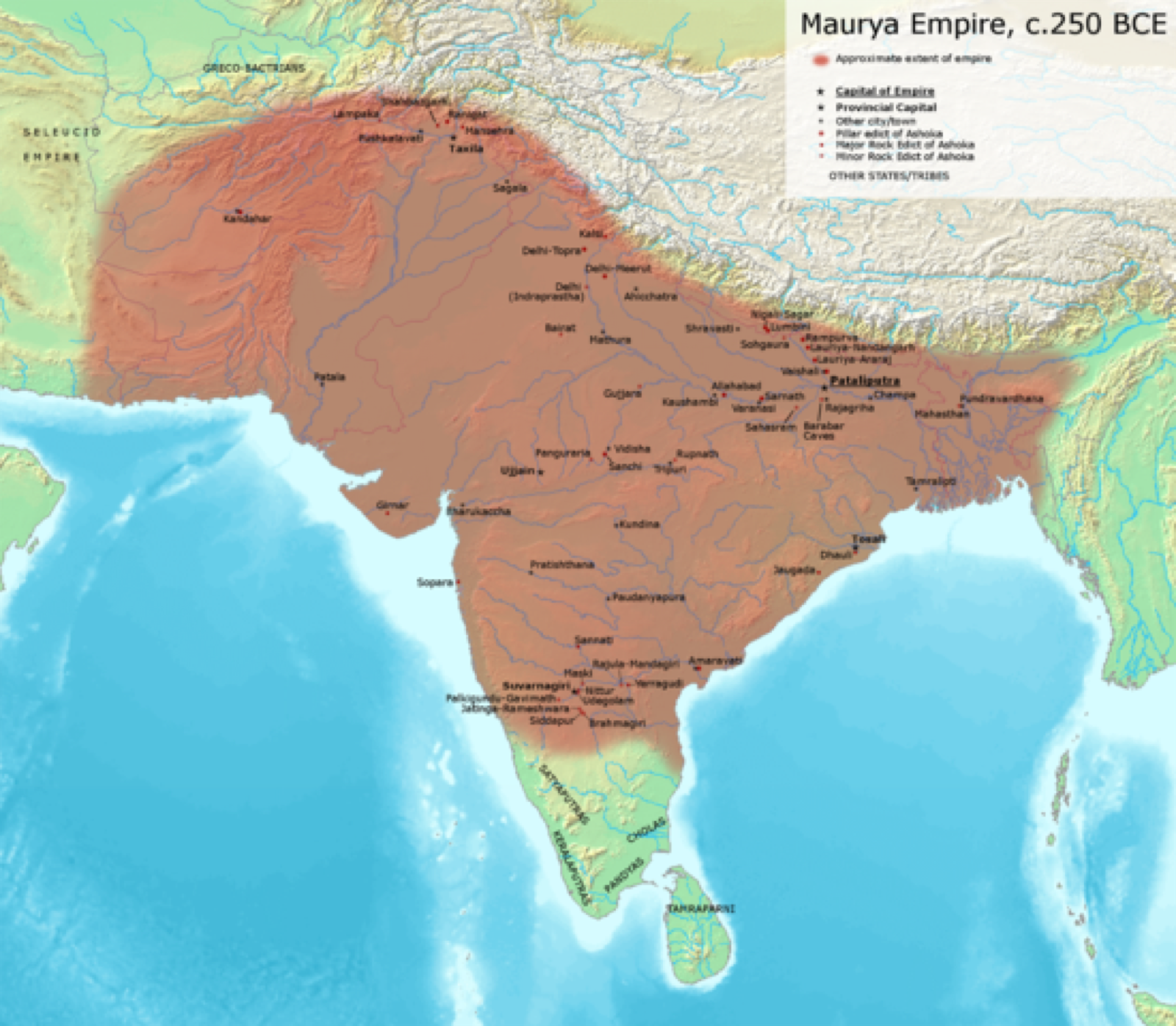
You will also see that, as soon as the centralising tendency began to disappear, it started to disintegrate and the term “really large empire” no longer began to apply. The later Mauryas (after Ashoka) and the Sungas and Kanvas, were largely confined to Magadha. They were done in by the decentralising tendency.
Another reason why Mauryan Empire had to rely on such an extensive bureaucracy was that most of these regions had not evolved state structures. South India and North Eastern regions were yet to see large state structures and hence there was no administrative organisation that Mauryans could make use of. This was set to change in the coming centuries.
Guptas
The other model is where the core area was under the direct control of the emperor while the rest was under kings who accepted his suzerainty.
By the time of Guptas, most parts of India had seen enduring state structures. This meant that the easier way to control those areas was to make use of existing structures than to impose a new administrative mechanism. This and the distance factor must have contributed to the decentralised nature of the State.
There is no doubt that Gupta polity had a large element of feudal tendencies in it. However, does it qualify for the “really large Empire” status? Let’s look at its extent.
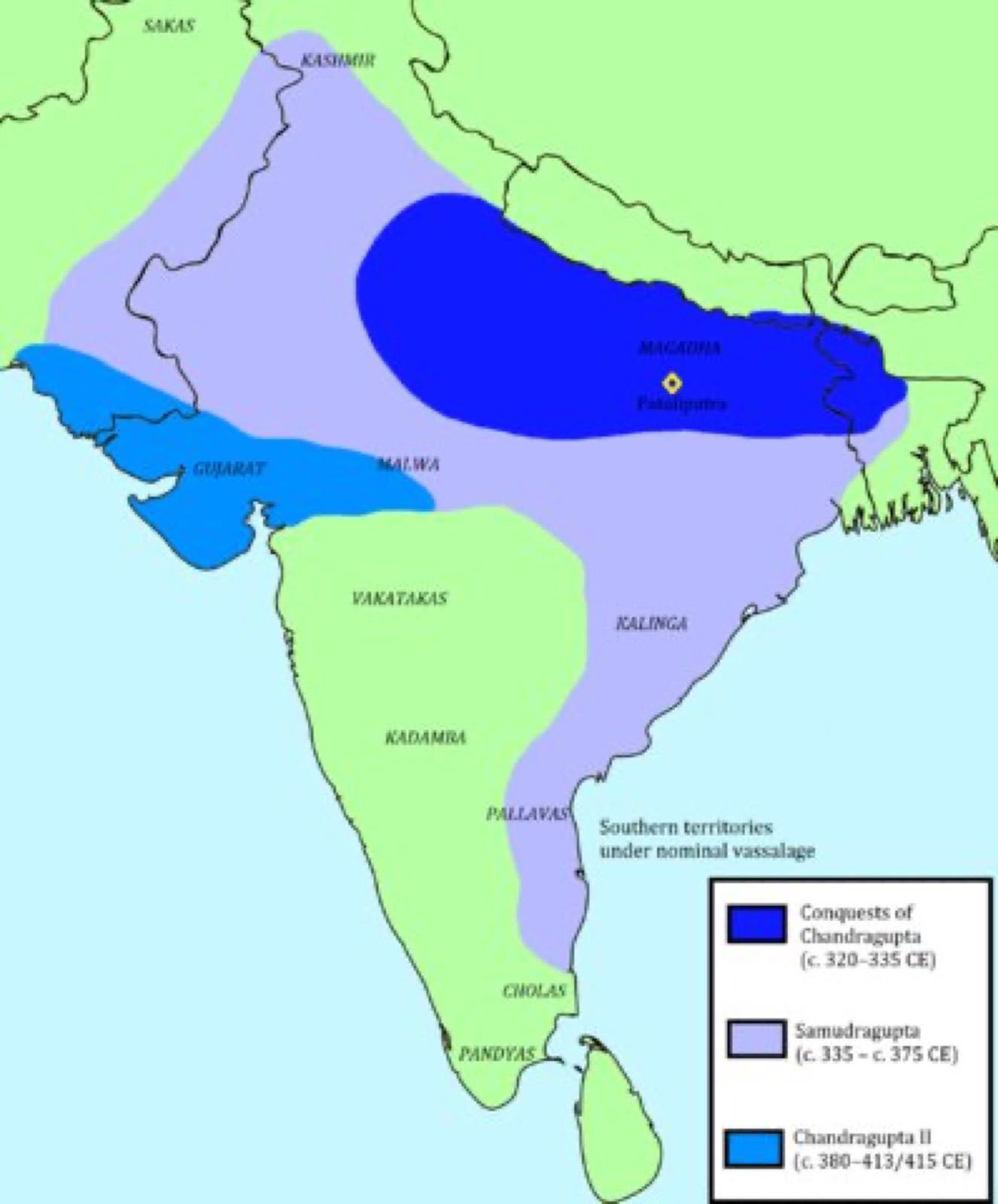
The core area of the Empire was always the doab and the Ganga plains. The Allahabad inscriptions of Harisena mentions that Samudragupta captured and let the South Indian Kings continue their rule. Was this because they were ruling on his behalf? The current opinion considers that this was not so. It was considered the norm in those days to let a defeated ruler to continue as long as he accepted defeat and acknowledged the winner’s suzerainity. It was because of this norm that Prithviraj let go of Muhammad of Ghur during the first battle of Tarain.
Besides, unlike the Mauryan times, regional sentiments were starting to emerge strongly. It would have been really difficult to exercise control over such far flung areas now that there were elements who could challenge the power of the emperor. This resulted in a mix of samanta system/ matrimonial alliances/ tribute system/ acceptance of Imperial Supremacy etc.
Did they really last that long?
Secondly , the question of survival. Did the large empires of India really survive a long time? The Mauryan Empire lasted merely through the rule of three emperors: Chandragupta, Bindusara and Ashoka. Is that a really long period in the history of Empires the world across? Not really. The Guptan Empire has a longer list, however its area of control was proportionately small.
Compared to the large Empire of the world, this was not a large amount of time. Consider this. The reigns of Emperors through Chandragupta to Ashoka was a combined paltry 88 years. The undivided Roman Empire lasted 400 years.
Large Empires can be said to have come to being through different mechanisms that suited its times. It is futile to search for a single mechanism that let them survive. But in general, we can see that there was some effective way of controlling and extracting surplus from all areas which would let it survive. As soon as this flow of surplus was disturbed, the Empire would start its downward fall.
Finally, the question of breaking away.
This did happen when the sustainability of the above models was threatened. In the first model, when the centralising agency became weak, the far flung areas broke away. In the second model, when the decentralisation went too far, the peripheral regions broke away.